

Sun-Gazette writes about pro bono program
From the Williamsport Sun-Gazette, June 7, 2004:
Local lawyers don’t shy away from pro bono work
Mike Reuther, Sun-Gazette Staff
The image of lawyers as money-grubbing shysters in expensive suits may be a fine characterization for a John Grisham novel.
In fact, corporate America’s slimier interests may even thrive with barristers of that ilk pleading their cases.
But don’t tell Lycoming County attorneys that they don’t care about helping their fellow man.
In fact, members of the Lycoming Law Association better think twice before trying to escape pro bono work.
Most of the county’s more than 100 attorneys, as it turns out, do their fair share of representing those who otherwise couldn’t afford a lawyer.
The Lycoming Law Association was recently selected as the winner of the 2004 Louis J. Goffman Award for organizational pro bono service. Each lawyer in the association fulfill an obligation by taking on three pro bono referrals a year, according to Dana Rich-Collins of North Penn Legal Services, which provides many of the referrals for local attorneys.
“It grew out of discussion for the need for this kind of work,” she said.
When an attorney is admitted to practice law in the county they are contracted by legal services, told how the referral program works, and given the chance to indicate how they want to participate.
Lawyers can fulfill their pro bono obligation in one of three ways: Many take on protection-from-abuse cases referred by legal services. Other kinds of cases are referred by legal services on an as-needed basis, and still others come when another lawyer cannot take them due to conflicts arising with clients.
Since 1985, the law association, along with the county president judge, has mandated that lawyers take three pro bono cases a year.
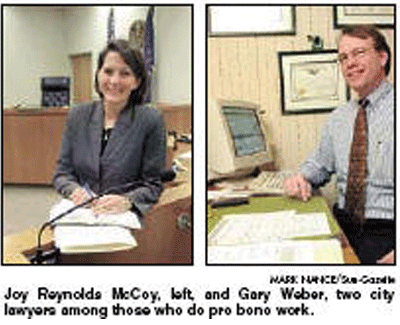
“I’ve never felt any different about my pro bono cases than I have my other cases,” said Joy Reynolds McCoy of the city law firm McNerney, Page, Vanderlin and Hall. “I think it’s good that you have this. It was just always instilled in me from the beginning.”
Jack Humphrey of the city law firm of Rieders, Travis, Humphrey, Harris, Waters and Waffenschmidt, recalled spending 22 days in trial on one pro bono case.
Fewer than than 10 attorneys, it was noted, have opted out of the pro bono obligations since the law association required such work.
Michael Collins of McNerney, Page, Vanderlin and Hall said that great pains are taken to ensure that local lawyers fulfill their pro bono work.
“When it’s expected, it helps,” said McCoy.
William H. Askey, an attorney for more than 60 years, said pro bono work just comes with the territory of being a lawyer.
“It’s an obligation,” he said. “We must do it.”
Local lawyers made it clear that taking on pro bono cases can mean the surrender of lucrative work.
For example, a lawyer’s retainer for a protection-from-abuse case typically is $500, according to McCoy.
Not surprisingly, much pro bono work is tied to domestic cases.
“That’s been very helpful,” said McCoy. “A lot of people in many cases can’t afford it.”
Contrary to belief, attorneys just getting established in the law are not eager to steer clear from pro bono work, simply because they need to build up their practices with any type of work they can get.
Thomas Raup, a former president judge now practicing law in the city, is credited with getting the referral program started.
“He twisted the arms of local attorneys to raise $100,000 for an endowment fund,” said Humphrey. “Law firms pledged $10,000 apiece.”
The endowment, he explained, is used to provide the legal costs of the poor.
“I was off the bench by then,” Raup recalled. “A resolution was passed to have each member of the bar pledge so much.”
Raup said he was astounded that a lawyers in a city the size of Williamsport were able to raise as much money as they did.
He said while he occasionally had to be “an autocrat and push someone” to get a law firm to give its share, most firms generally live up to their pledges.
Jonathan E. Butterfield of Murphy, Butterfield and Holland said that an attorney simply must take the legal work done for pro bono clients as seriously as that done for others.
The law association and its members provide other services in addition to traditional pro bono work.
Attorneys and volunteer paralegals, for example, conduct divorce clinics for abuse victims. Other members serve as mentors or co-counsel to the legal services staff, while still others conduct “behind-the-scenes work,” researching and authoring briefs in cases handled by legal services.
